
How to create a private label incense brand
Key takeaway: private label manufacturing allows brands and retailers to launch a premium incense range without investing in their own production tools. This model can speed up time to market while relying on a partner who already masters formulation, production and regulatory requirements. It also offers greater flexibility for professionals who want to test a concept before building a fully developed collection.
This guide is designed to explain how private label incense manufacturing works. To discover our professional service directly, you can visit our dedicated page for private label incense manufacturing.
Launching an incense collection under your own brand can quickly become complex when formulation, compliance, sourcing and production are involved. For many retailers, concept stores and wellness brands, private label manufacturing offers a practical way to build a distinctive product line without having to create a production structure from scratch.
This guide explains how the private label model works, why it is attractive for professionals, how to compare artisanal and industrial approaches, and what to check before choosing a reliable incense manufacturer for your project.
- Understanding how private label incense manufacturing works
- Why private label is a strategic tool for professionals
- Artisanal production vs industrial production
- How to choose a reliable incense manufacturer
- Strategic summary for launching a private collection
Understanding how private label incense manufacturing works
Private label incense manufacturing is based on a simple principle: a specialized producer develops and manufactures the product, while the brand or retailer markets it under its own identity. This model allows professionals to focus on branding, distribution and customer experience without having to manage production internally.
Definition of the model and role distribution
In a private label project, the manufacturer handles the technical side of the work: product development, production methods, fragrance stability, sourcing and manufacturing consistency. The client focuses on brand positioning, visual identity, packaging choices and distribution.
This makes private label particularly attractive for retailers and young brands that want to launch a product line without building their own workshop or investing in research and development from the start.
European regulations and compliance requirements
Any incense product sold on the European market must respect the regulatory framework applicable to fragrance products and chemical mixtures. This generally means compliance with REACH and CLP requirements, as well as clear safety documentation and proper labeling where necessary.
A serious manufacturer should be able to provide the documents needed for the finished product, including Safety Data Sheets when relevant, and explain how compliance is handled throughout the production process.
Why private label is a strategic tool for professionals
Beyond the technical aspect, private label manufacturing can become a real growth lever for retailers, concept stores and wellness brands looking to differentiate their offer.
Faster launch and lower production investment
Developing an in-house fragrance product line requires time, technical expertise and significant investment. Private label reduces these barriers by relying on an existing manufacturing structure that is already operational.
Instead of investing in formulation trials, sourcing systems and production equipment, the brand can focus on building a market-ready offer more quickly. This is especially useful for businesses that want to test a concept, validate demand or expand their catalogue efficiently.
Customer loyalty through a distinctive scent identity
A private label incense range can help create a more recognizable and memorable brand universe. A distinctive scent profile, combined with a coherent visual identity, can strengthen customer attachment and support repeat purchases.
For retailers and lifestyle brands, this is often one of the most attractive aspects of the model: it becomes possible to offer something more exclusive than a standard resale catalogue.
Flexible formats and more control over positioning
Private label also offers more flexibility in terms of product format, packaging and brand positioning. A business can start from a simple concept, test a few fragrances or containers, then gradually refine the collection based on customer feedback and sales performance.
For some projects, this flexibility starts with bulk supply before evolving toward a more developed private label offer.
Artisanal production vs industrial production
The type of manufacturing partner you choose will depend largely on your market positioning. Artisanal and industrial production do not communicate the same values, nor do they serve the same commercial strategy.
The appeal of artisanal production and gentle diffusion
Artisanal manufacturing is generally associated with smaller batches, greater product individuality and a more distinctive brand story. For businesses positioned around authenticity, craftsmanship and premium sensory experience, this can be a strong advantage.
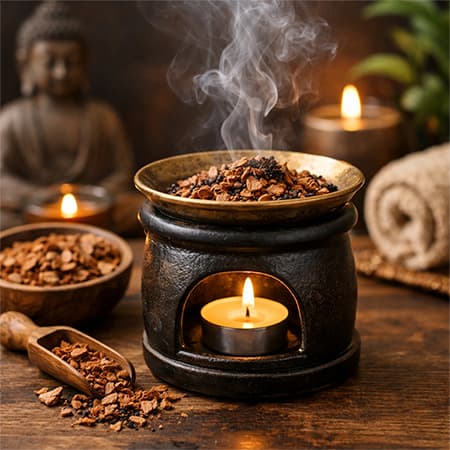
In the case of wood-infused incense, artisanal production also supports a more specific product identity: natural wood chips infused with fragrance, designed for gentle diffusion on a candle burner rather than direct combustion.
This type of positioning is particularly attractive for concept stores, boutique retailers and brands seeking a refined, modern alternative to more conventional incense formats.
Industrial production and standardized volumes
Industrial production offers another type of advantage: consistency at larger scale, standardized formats and easier management of high-volume distribution. For some projects, especially those targeting broader retail channels, this can make logistical sense.
The choice therefore depends on the nature of the brand you want to build. Some businesses prioritize scale and price optimization, while others prioritize uniqueness, product story and sensory positioning.
How to choose a reliable incense manufacturer
Once the project direction is clear, choosing the right manufacturing partner becomes one of the most important strategic decisions. Not all suppliers offer the same level of transparency, flexibility or support.
Selection criteria: transparency, ethics and product coherence
A reliable manufacturer should be able to explain clearly what the product is, how it is produced and what standards it meets. For many brands, this also includes attention to formulation choices such as the absence of substances classified as CMR, the avoidance of phthalates and the use of vegan compositions.
Beyond documentation, the overall coherence of the product matters as well: raw material quality, fragrance consistency, production traceability and alignment with the desired market positioning.
Logistical capacity and professional support
It is also important to evaluate order flexibility, production lead times, minimum order quantities and the manufacturer’s ability to support the brand over time. Some businesses may start with modest volumes before scaling, so a partner’s capacity to adapt is a real advantage.
Brands that are still comparing different sourcing models may also benefit from reviewing the offer of a wholesale incense supplier in order to understand how bulk supply, catalogue logic and professional distribution fit into the broader project.
Strategic summary for launching a private collection
Launch your incense brand with a French manufacturer
Maison de l’Encens works with professionals who want to develop their own collection through French artisanal manufacturing.
Discover our private label incense service
View our wholesale incense offer
Launching a private incense collection requires a balance between brand identity, technical reliability and product coherence. A strong concept alone is not enough: long-term success depends on choosing a manufacturing partner capable of translating that vision into a consistent, compliant and market-ready product.
Balancing visual identity with technical quality
Packaging, brand story and visual design all play an important role, but they only create lasting value if the product itself is technically reliable and aligned with the promise made to the customer. In private label projects, the relationship between image and product quality is central.
This is why many brands start with a focused collection, then build gradually as they gain better insight into what their customers respond to most strongly.
Growth potential for specialized retailers and emerging brands
For specialized retailers and young lifestyle brands, private label incense can become more than just a product extension. It can support a stronger identity, improve perceived exclusivity and create a more coherent sensory experience across the brand universe.
When built on a reliable manufacturing base, private label can combine regulatory clarity, flexible market access and long-term product differentiation without the burden of building a full industrial structure internally.
FAQ
What does private label incense manufacturing actually involve?
Private label manufacturing means that a specialized producer develops and manufactures the incense product, while the retailer or brand sells it under its own name and visual identity. This allows businesses to launch their own collection without managing production internally.
What regulatory requirements apply to incense sold in Europe?
Products sold in Europe generally need to comply with the relevant REACH and CLP requirements, depending on their composition and classification. A serious manufacturer should be able to provide the necessary documentation for the finished product and explain the applicable compliance framework.
What should a brand look for in a reliable incense manufacturer?
Important criteria include transparency, product consistency, regulatory clarity, flexibility on minimum order quantities and the manufacturer’s ability to support the project over time. For private label projects, the quality of communication and the coherence of the product are just as important as production itself.
What is the difference between artisanal and industrial incense manufacturing?
Artisanal manufacturing is generally associated with smaller batches, stronger product identity and a more premium positioning, while industrial production is designed for larger standardized volumes. The right choice depends on your brand strategy and commercial objectives.
Can a business start with small quantities before launching a full private label collection?
Yes. Many projects begin with a more flexible approach, sometimes through bulk supply or limited tests, before evolving toward a more structured private label offer. This helps validate customer demand before investing in a fully developed collection.
Share this article:




Similar posts
Wholesale incense for retail: how to choose the right supplier
Looking for a reliable wholesale incense supplier? Discover how retailers choose the right partner and build a profitable incense offering.

Bulk incense for professionals: benefits for retailers
Discover why bulk incense helps retailers improve margins, reduce packaging costs and build a more flexible, distinctive fragrance offer.