
Incense for concept stores: which scents should retailers choose?
Key takeaway: in a concept store, incense should never feel random. The scents selected need to extend the identity of the space, support its sensory atmosphere and remain easy for customers to understand. A short, well-curated range is usually far more effective than a large but inconsistent selection.
A concept store is not defined only by the products it sells, but by the atmosphere it creates. Every category contributes to that identity, including fragrance. In this context, incense is more than a scented product: it becomes part of the visual, emotional and sensory language of the store.
For incense to work well in a concept store, the selection has to be deliberate. Too many references can blur the offer, while a focused range built around a few clear scent directions can strengthen product readability and make the category feel more refined.
- Why scent selection matters so much in a concept store
- Which scent families work well in concept stores?
- How to build a coherent selection
- Which scents can work as entry-level references?
- How to expand the range without losing clarity
- From bulk supply to a more exclusive signature
- FAQ
Why scent selection matters so much in a concept store
In a concept store, customers are not only buying products. They are responding to a point of view, an aesthetic and a lifestyle atmosphere. That is why incense has to feel aligned with the broader identity of the space.
Incense extends the identity of the store
A well-chosen scent can reinforce the mood of the store immediately. It may evoke something cleaner, warmer, softer, more floral, more textured or more contemplative. A poorly chosen scent, on the other hand, can feel disconnected from the rest of the retail experience.
In that sense, each incense reference should have a clear role in the selection rather than simply being added to increase product count.
The product must be easy to present and recommend
A good incense scent for a concept store is not just pleasant. It should also be easy for the retail team to explain, position and recommend. The clearer its personality, the easier it becomes to connect it to the wider universe of the store.
This is particularly true with artisan incense made from natural wood chips infused with fragrance and intended for use on a candle burner, where format and usage are part of the product story.
Which scent families work well in concept stores?
There is no universal fragrance palette for all concept stores, but some scent families tend to integrate especially well into curated retail environments.
Soft and luminous florals
Well-balanced floral scents often create an elegant, accessible and refined atmosphere. They work particularly well in stores that want to feel calm, sophisticated and welcoming without becoming too heavy or too demonstrative.
References such as Jasmine or Orange Blossom can support this kind of atmosphere by bringing clarity and softness to the range.
Woody and textured profiles
Woody, musky and more enveloping scent profiles tend to work well in décor-oriented, lifestyle or design-led concept stores. They add more depth and character to the category and can help the store create a more textured sensory identity.
Profiles such as Sandal Oud can enrich the range by adding structure and olfactory depth.
Soft comforting scents
Powdery, musky or gently comforting references also have their place, especially in stores that want a warmer and more cocooning atmosphere. These scents often make the category easier to approach for customers who are less familiar with incense.
In this role, scents such as White Musk or Vanilla can function as reassuring anchors within a more curated range.
How to build a coherent selection
In a concept store, coherence matters more than quantity. A small but intentional range usually feels more refined than an oversized assortment with no clear direction.
Build the range around a few clear roles
One effective method is to structure the selection around a few identifiable functions: a floral and accessible scent, a more woody and textured one, a soft comforting profile, and perhaps one more distinctive composition to give extra character to the category.
This kind of organization makes the category easier to understand, easier to merchandise and easier to recommend.
Keep a consistent aesthetic and sensory line
A concept store is fundamentally editorial. Every reference should feel like it belongs to the same overall universe. A scent may be excellent in isolation while still feeling out of place within the store’s atmosphere.
That is why fragrance selection should always be filtered through the visual and emotional identity of the business, not only through individual preference.
Which scents can work as entry-level references?
In a concept-store incense range, some references can act as entry points into the category. They help customers discover the offer more easily and create a first level of familiarity.
Scents that are immediately understandable
A strong entry-level reference is often a scent that feels easy to project and easy to name. Jasmine, Orange Blossom, White Musk or Vanilla often work well in that role because they are readable even for customers who are new to the category.
These references create confidence and make it easier to introduce more nuanced or more distinctive profiles later in the range.
More characterful scents as a second layer
Once that base is established, the store can introduce more expressive, woody or textured compositions. References such as Amber Indian or Sandal Oud can then help give the category more personality without making it harder to understand.
This layered structure helps the concept store become more distinctive while remaining approachable.
How to expand the range without losing clarity
A concept store range should not remain fixed forever, but it should not evolve in a random way either. Expansion works best when it is grounded in observation.
Observe customer response before adding more references
Sales performance, spontaneous reactions, repeat requests and the ease with which certain scents are recommended all offer valuable signals. These indicators help identify which scent families truly belong in the store and which references deserve more space over time.
This approach is much healthier than simply increasing the number of products for the sake of variety.
Keep sourcing flexible
To expand intelligently, the store also needs a sourcing model that allows quantities and references to be adjusted without unnecessary rigidity. Supplier flexibility is therefore essential to building a long-term category strategy.
Retailers who want to work with a more progressive selection may benefit from relying on a wholesale incense supplier offering sourcing conditions better suited to concept stores and specialized retail spaces.
From bulk supply to a more exclusive signature
In many cases, a concept store begins by selecting a few existing references in bulk, then refines the offer gradually as the category becomes more clearly defined.
Bulk supply as a range-building tool
Bulk formats make it easier to test several scents, adapt the presentation to the store identity and identify the references that work best in the real context of the business. This is often the most practical way to start without overloading stock.
For a concept store, that first stage is valuable because it allows the range to be built with more flexibility and more coherence.
A more exclusive identity can come later
Once the strongest references are identified and the olfactory direction of the store becomes clearer, some retailers choose to move toward a more exclusive and more brand-aligned offer.
At that point, it can become relevant to explore a private label incense service in order to develop a more distinctive and personalized range.
FAQ
How many scents should a concept store offer?
It is often better to begin with a short but coherent range rather than with too many references. The goal is to keep the category easy to understand and easy to refine over time.
Which scent families work best in concept stores?
Soft florals, elegant woody profiles, musky comforting scents and a few more characterful compositions often work well, as long as they remain coherent with the identity of the store.
Should retailers focus on familiar scents or more original ones?
Both have a place. Familiar scents help customers enter the category more easily, while more distinctive references give the range stronger character. The key is to keep the progression readable.
Is bulk incense suitable for concept stores?
Yes. It often allows more flexibility in presentation, a more gradual selection process and a stronger alignment with the visual identity of the store.
Can the range become more exclusive over time?
Yes. Many concept stores begin with existing references, then move toward a more personalized and more exclusive range once their strongest scents and their olfactory direction are more clearly established.
Share this article:




Similar posts
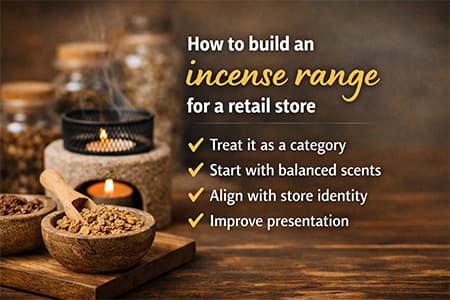
How to build an incense range for a retail store
Learn how retailers can build a clear, coherent incense range, choose the right scents, improve presentation and grow the category progressively.

Bulk incense or private label: which model fits your retail project?
Compare bulk incense and private label to understand which model best fits your retail project, growth stage and long-term brand goals.