
Minimum order quantity for incense: what retailers should know
Key takeaway: minimum order quantity, or MOQ, plays a major role in how a retailer builds an incense offer. A MOQ that is too high can limit flexibility, tie up stock and increase financial risk, while a more accessible threshold makes it easier to test fragrances, structure a range progressively and move toward a more distinctive long-term product strategy.
When a retailer decides to introduce incense into a store, one of the first practical questions is often the minimum order quantity. How much product is required to start? Is the supplier’s MOQ realistic for a small or mid-sized retail project? And how can a business test several fragrances without committing to excessive stock too early?
In the professional incense market, MOQ is not just a logistical detail. It affects cash flow, product testing, catalogue structure and long-term sourcing strategy. For retailers, concept stores and wellness boutiques, understanding MOQ is therefore essential before choosing a supplier or building a new fragrance range.
- What does MOQ mean in the incense market?
- Why minimum order quantity matters for retailers
- What kind of MOQ can suit a retail store?
- How to test an incense range without overstocking
- How to evaluate a supplier through its MOQ
- From first orders to a more personalized range
- FAQ
What does MOQ mean in the incense market?
MOQ stands for Minimum Order Quantity. It refers to the smallest quantity a supplier is willing to sell for a given order. In the incense sector, this minimum can be expressed by weight, by units or by quantity per fragrance reference.
This matters because not all suppliers work in the same way. Some require larger production volumes from the outset, while others offer more flexible entry points better suited to independent retailers, concept stores or businesses that want to test several scents before expanding their range.
For professional buyers, MOQ should therefore be understood as part of the supplier’s overall business model. It says a lot about flexibility, stock logic and the kind of retail partner the supplier is prepared to work with.
Why minimum order quantity matters for retailers
A high MOQ can create unnecessary pressure on stock and cash flow, while a more accessible MOQ makes it easier to introduce a new product category with less risk. For retailers, this balance is often one of the key factors in deciding whether a professional incense offer is realistic.
It directly affects cash flow
For a store, adding incense is not only about selecting attractive fragrances. It also means deciding how much capital can be allocated to a new range without reducing flexibility elsewhere in the buying budget.
If the minimum quantity is too high, too much money may be tied to a single reference or to a limited number of fragrances. This makes it harder to test the market gradually and can delay the development of a more balanced assortment.
It influences the width of the range
MOQ also affects how many scents a retailer can offer from the start. If every fragrance comes with a high minimum threshold, the selection naturally becomes narrower. Yet in the incense category, variety is often part of what helps a retail offer feel richer and more interesting to customers.
A lower or more flexible MOQ makes it easier to test several olfactory profiles at once. This gives the retailer better visibility on which references actually perform in-store.
What kind of MOQ can suit a retail store?
There is no single ideal MOQ for every retail project. The right threshold depends on store size, storage capacity, number of fragrances being tested, expected sales rhythm and how central incense is within the overall offer.
The right MOQ depends on the retail model
A store already specialized in home fragrance or sensory products will not have the same needs as a concept store adding incense as a complementary category. In the first case, higher quantities may be absorbed more easily. In the second, a more progressive start is often preferable.
The most suitable MOQ is therefore the one that allows the retailer to test the category seriously without creating disproportionate stock pressure from the outset.
A flexible threshold supports market testing
When the minimum quantity is more accessible, retailers can test fragrances in a more rational way. Instead of making a heavy commitment too early, they can compare customer response across several references and build their range on actual results.
This is one reason why many professionals choose to work with a wholesale incense supplier able to offer a sourcing model that better matches the realities of resale and gradual category development.
How to test an incense range without overstocking
MOQ becomes especially important during the launch phase, because it shapes how a retailer can test an incense category before deciding how far to expand it.
Start with a focused fragrance selection
In many cases, it is more effective to begin with a small but coherent selection than to launch with too many references at once. A smaller range makes it easier to track sales, observe customer preferences and identify which scent profiles are worth expanding later.
A realistic MOQ supports this approach by making it possible to test the category without turning the first order into a heavy stock commitment.
Expand the range in stages
Once the first references prove their relevance, the store can develop the category more progressively. This staged approach is healthier because it is based on real demand and customer response rather than assumption alone.
In that sense, a flexible supplier does more than provide product: it also supports a more sustainable retail rollout strategy.
How to evaluate a supplier through its MOQ
MOQ should never be looked at in isolation. It needs to be considered alongside product quality, stock consistency, packaging logic and the supplier’s ability to work with professional buyers over time.
A high MOQ does not automatically mean better quality
A large minimum order may simply reflect an industrial model or a rigid production structure. It does not automatically indicate better craftsmanship or better resale potential.
For a retailer, the key question is whether the supplier understands the realities of store-level resale and offers a model compatible with gradual category building.
MOQ only matters when the product itself is coherent
The minimum threshold only makes sense if the product is suited to the store’s positioning and customer base. In the case of artisan incense made from natural wood chips infused with fragrance and intended for use on a candle burner, MOQ should be read together with the product’s originality, perceived quality and resale potential.
In other words, an acceptable MOQ is not just about quantity. It is also about whether the store gains access to a product that is distinctive enough to justify the investment.
From first orders to a more personalized range
MOQ also plays a role in the longer-term evolution of a retail project. In many cases, a store begins by testing existing references before moving toward a more exclusive and personalized offer.
Bulk supply as a learning phase
Bulk formats make it easier to understand which fragrances perform best, what type of presentation works in-store and how the category fits within the broader identity of the business. This first stage often provides valuable insight before any deeper product customization is considered.
That is why bulk sourcing often works as a learning phase for retailers entering the category.
A natural transition toward private label
Once certain references have clearly proven their relevance and the store wants to strengthen its own identity, the next step may be a more personalized collection. At that stage, MOQ remains important, but within a different logic: the goal is no longer only to test, but to structure a range around the retailer’s own brand universe.
This is where some businesses naturally begin exploring a private label incense service, once the most suitable fragrances and positioning have already been validated.
FAQ
What does MOQ mean for a retailer selling incense?
MOQ refers to the minimum order quantity required by a supplier. For a retailer, it determines how much product must be purchased at the start and directly affects budget, range width and stock risk.
Is a low MOQ always better?
Not in every case, but it is often better suited to retailers who want to test the category, introduce several fragrances progressively or avoid overcommitting stock at launch.
How can I tell whether a supplier’s MOQ is realistic for my store?
You need to compare it with your store size, available storage, number of references you want to launch and expected sales rhythm. A good MOQ is one that lets you test the category without creating disproportionate stock pressure.
Is MOQ the same for bulk supply and private label?
Not always. Bulk supply often offers more flexibility at the beginning, while private label projects usually involve a more structured development process and therefore different quantity thresholds depending on the level of customization.
Why is MOQ important when choosing a supplier?
Because it reveals part of how the supplier works. It helps you assess flexibility, understanding of retail realities and the supplier’s ability to support a store that wants to build an incense offer progressively and coherently.
Share this article:




Similar posts
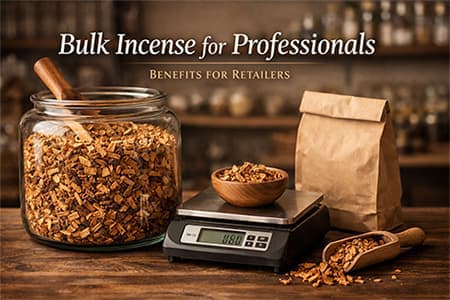
Bulk incense for professionals: benefits for retailers
Discover why bulk incense helps retailers improve margins, reduce packaging costs and build a more flexible, distinctive fragrance offer.

How to choose an incense supplier in Europe
Learn how retailers can compare incense suppliers in Europe, assess quality, MOQ and flexibility, and choose a sourcing model that fits their retail strategy.