
How to test an incense range before launching a branded collection
Key takeaway: before investing in a branded incense collection, retailers should first test the category in a controlled and flexible way. A smaller trial phase makes it easier to identify the right scent directions, understand customer response, refine presentation and reduce the risk of building a collection around assumptions rather than real market feedback.
Launching a branded incense range can be an attractive next step for a concept store, wellness boutique or fragrance-led retail business. But moving too quickly into a more exclusive collection can also create unnecessary rigidity if the strongest fragrances, retail positioning and customer expectations have not yet been properly validated.
For many retailers, the most effective approach is to begin with a test phase. This allows the business to understand how incense performs in-store, which scent families work best, how much variety is actually needed and what kind of presentation supports the category most effectively. In other words, testing the range first often leads to better long-term decisions later.
- Why testing the category first is often the smartest step
- What retailers should validate before going branded
- How to build a test selection without overcomplicating it
- What to observe during the test phase
- Why flexible sourcing makes testing easier
- When a branded collection becomes a logical next step
- FAQ
Why testing the category first is often the smartest step
Before building a branded incense collection, the retailer first needs to understand whether the category really fits the store, how customers respond to it and which references deserve to become part of a longer-term offer.
It reduces avoidable risk
Creating a branded collection too early can lead to costly decisions built on incomplete information. If the store has not yet identified its strongest fragrances, understood its customers’ scent preferences or clarified the role of incense within the wider offer, exclusivity may come before certainty.
Testing first helps reduce that risk. It gives the retailer room to learn before making the category more structured and more brand-led.
It creates better foundations for positioning
A branded collection should not be built only on taste or intuition. It should be based on what actually works in context: which scents are remembered, which references sell more easily and which olfactory direction feels most coherent with the store’s identity.
That kind of clarity usually comes from real retail observation, not from abstract projection alone.
What retailers should validate before going branded
Before moving toward a more exclusive range, several elements should already be reasonably clear.
The role of incense inside the store
The retailer should first understand how incense functions within the business. Is it a complementary category, a strong sensory signature, an entry-level fragrance offer or a more selective premium category? The answer affects both product selection and long-term brand direction.
If that role is still unclear, it is usually too early to formalize the range under a more fixed branded structure.
The strongest scent directions
A business does not need to validate every possible fragrance before moving forward, but it should at least know which scent families resonate most with its audience. In many cases, the question is not “which individual scent do we like best?” but rather “what kind of olfactory world makes sense for this store?”
That could mean realizing that softer florals perform better than expected, or that woody profiles create a stronger identity than more familiar entry-level references.
How to build a test selection without overcomplicating it
The test phase should stay manageable. Its purpose is not to represent the whole market, but to create enough contrast to observe what works.
Start with a focused and readable range
A smaller, curated test range usually performs better than a large assortment launched too early. The goal is to compare a few coherent scent directions, not to overwhelm the customer with too many references at once.
For example, a retailer may begin with a floral reference such as Jasmine, a soft and familiar profile such as Orange Blossom, a more textured woody profile such as Sandal Oud, and a more characterful option such as Indian Amber.
This kind of structure gives the retailer enough contrast to observe preferences without turning the test phase into a fully developed catalogue.
Keep the selection coherent with the store identity
Even during testing, the range should not feel random. The references chosen should already make sense within the visual and emotional world of the business. A concept store with a soft, elegant atmosphere will not necessarily test the same scent directions as a darker, more textured lifestyle space.
The test phase should therefore remain curated, even if it is still exploratory.
What to observe during the test phase
Testing a range is not only about counting which references sell. It is also about observing how the category behaves in real life.
Sales are important, but not the only signal
Of course, actual sales matter. But retailers should also look at what customers smell first, which references attract spontaneous comments, which scents are easier to recommend and which products feel most natural within the store display.
Sometimes a fragrance generates curiosity but not repeat interest. Sometimes another one sells more quietly but becomes a stronger long-term anchor for the category.
Ease of presentation matters too
A scent may be very beautiful and still not be the best candidate for a branded collection if it is difficult to explain or hard to position within the store’s wider offer. During the test phase, it is useful to note which references are easiest for the team to present and which ones integrate most naturally into the store’s merchandising.
A future branded collection should be built around references that are not only appreciated, but also commercially usable.
Why flexible sourcing makes testing easier
A good test phase depends heavily on sourcing conditions. If the supply model is too rigid, the retailer may be forced to overcommit before the category is mature enough.
Testing works best with adaptable quantities
Retailers need room to test different references, adjust quantities and reorder stronger performers without friction. That is why flexibility matters more in the early phase than exclusivity.
For many businesses, bulk supply provides a more realistic and manageable framework for this kind of experimentation.
A flexible supplier supports better long-term decisions
When the sourcing model is adaptable, the retailer can focus on understanding the category instead of simply absorbing stock. That creates a much healthier foundation for later strategic choices.
Retailers looking for that kind of progressive launch model may benefit from working with a wholesale incense supplier able to support testing, gradual selection and professional resale.
When a branded collection becomes a logical next step
The branded phase usually becomes relevant once the test phase has already answered the most important questions.
Move forward once the range feels stable
When the retailer can clearly identify the strongest references, the most coherent scent direction and the intended role of incense in-store, the category becomes much more ready for a branded evolution. At that stage, the decision is no longer based mainly on assumptions, but on a more stable commercial understanding.
That is what makes the next step more strategic and less speculative.
Branding works better once the category is already validated
A branded collection should feel like an extension of an already credible retail offer, not like an attempt to define the category before it has proved itself. When the groundwork has already been done, exclusivity becomes much easier to justify and much easier to position.
For retailers who reach that point, a private label incense service can become the logical continuation of the project.
FAQ
Why should retailers test an incense range before launching a branded collection?
Because testing helps validate which fragrances work, how customers respond and what kind of positioning makes sense before the retailer moves into a more fixed and exclusive structure.
How many scents should be included in a test phase?
A small but contrasted selection is usually enough. The goal is to compare a few clear scent directions, not to launch a full catalogue too early.
What should retailers observe during the test phase?
They should look at sales, customer reactions, ease of recommendation, how the references perform in-store and which scent direction feels most coherent with the business.
Why is bulk supply useful for testing?
Because it often offers more flexibility in quantities and makes it easier to refine the range gradually before moving toward a more exclusive offer.
When is the right time to move toward a branded collection?
It usually makes sense once the strongest references are clear, the category is more stable and the retailer has a better understanding of the scent direction that fits the brand.
Share this article:




Similar posts
Bulk incense or private label: which model fits your retail project?
Compare bulk incense and private label to understand which model best fits your retail project, growth stage and long-term brand goals.
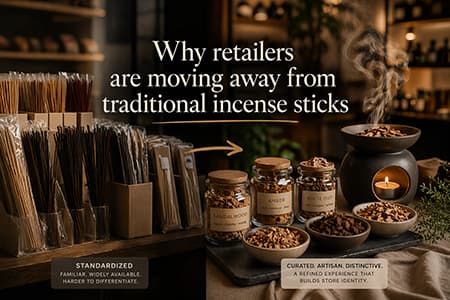
Why retailers are moving away from traditional incense sticks
Discover why more retailers are looking beyond traditional incense sticks and choosing more curated, distinctive fragrance formats for premium stores.